COLLECTOR GUIDE
What VMG and AMG Actually Grade, and What Certified Uncirculated Does Instead

Jeffrey Smith
5 Minutes Read
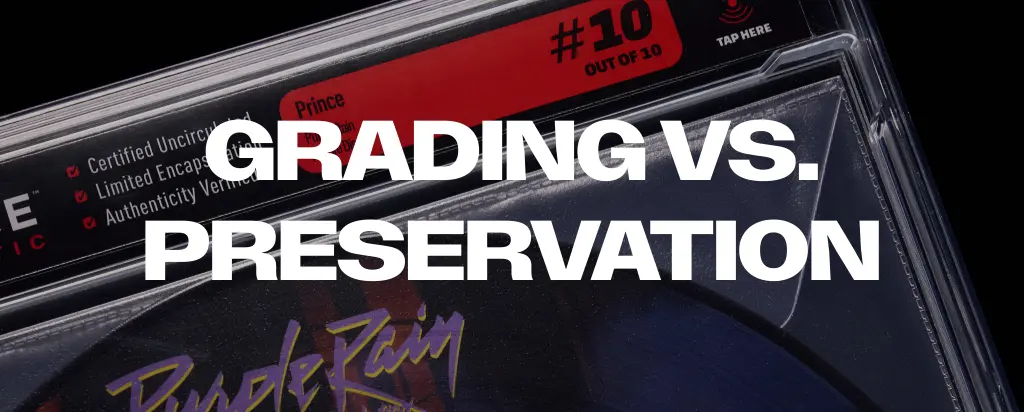
A grade only tells you what already happened to a record.
Vintage Media Grading (VMG) and Audio Media Grading (AMG) both built businesses on that idea. Submit a record, and they’ll grade its condition, assign it a number, and seal it in a case. It’s a real service. For a record that’s spent thirty years on shelves and turntables, a grade gives that history a number worthy of trust.
Certified Uncirculated works on a different premise: it confirms nothing has happened to the record… at all.
What VMG and AMG Actually Grade
Both companies grew out of the same idea that transformed comics and trading cards, putting a ranking number on a piece’s condition and sealing it behind that number. VMG traces back to 2018, when Andrew Hoffman founded its predecessor, Audiophile Archive & Grading Services, which merged into VMG in 2022. AMG came later, launched in 2023 by Steve Aoki alongside Collector Archive Services, with Jeremy Downs running the company as CEO. By 2024, AMG had already bought Tuned In Grading, a Dallas rival barely a year old, folding three separate grading startups into one business in under two years. The category seems to be consolidating fast.
Both use a version of the Goldmine standard, the condition scale collectors have used informally for decades, and convert it into a 1-to-10 number. For records that have been opened, both companies issue two sub-grades: one for the packaging, one for the vinyl itself. Those two grades matter, because it’s the seam where the sealed-record question actually lives.
The Part Their process Admits
Here’s the detail that matters most, and it comes straight from AMG’s own published grading scale: for a sealed record, the company evaluates two things only, the cover and the shrink wrap. Splits, stains, notched corners, sticker damage. AMG never inspects the vinyl inside, because inspecting it means opening the package.
A grade on a sealed record only ever grades the wrapper, at AMG or anywhere running the same process. The vinyl itself sits inside untouched, whatever condition it’s actually in.
VMG’s own pricing page shows the identical problem. They offer “crossover grading,” where a technician breaks the seal to grade the record itself, and their site warns upfront that breaking the seal risks damaging the piece. Once VMG opens a record to check what’s under the shrink wrap, the seal is gone for good.
That’s the honest version of the “how do you grade a sealed record” question. You don’t. AMG and VMG both grade the box it came in. Ask for more, like VMG’s crossover grade, and the seal has to come off to get it.
What Certified Uncirculated Verifies Instead
Certified Uncirculated starts before that problem exists at all, at the point a record is pressed and set aside, not after it’s already sealed and shipped.
Alliance Authentic preserves a Certified Uncirculated piece before it ever reaches retail, sourced through relationships across labels, artists, and the broader distribution chain, before public sale begins. Little time passes between the pressing and the preservation, so there’s nothing for the piece to pick up along the way: no shelf time, no retail or collector handling, nothing to grade later.
Certified Uncirculated asks one thing: did this record ever leave the warehouse floor before Alliance Authentic preserved it? That question gets settled the moment the piece is preserved, with nothing left over to inspect or reconstruct later.
What AMG and VMG Are Actually Selling
AMG describes its own mission as serving “collectors and investors,” tying encapsulation directly to protecting a record’s value. VMG goes further: it describes vinyl records as assets “waiting to reach their full potential” and offers to convert graded pieces into NFTs, marketed as a path to what it calls an investable asset. Aoki himself has said as much in interviews, framing the goal as letting records appreciate the way trading cards did during the pandemic-era boom.
AMG and VMG say plainly what they’re building: an investment category, borrowed straight from cards and comics, applied to vinyl.
Alliance Authentic preserves a record for what it already is: a pressing tied to an artist or release that means something to the collector holding it. Nothing about it needs to go up in value for that to be true.
Collectors on the Steve Hoffman Music Forums called VMG “a step too far” when it launched, and that reaction hasn’t gone away. The pushback runs loudest from people who buy vinyl to actually play it.
What Actually Travels With The Vinyl
A grade is a snapshot. AMG’s hologram and Statement of Archival let a buyer confirm a serial number and a grade assigned on one specific day, fixed at that moment and never revisited.
Tap the Alliance Authentic chip, and the record’s identity travels forward to every collector who takes stewardship of it next. Each peer-to-peer exchange adds another entry to that history, collector to collector.
The Bottom Line
AMG and VMG answer a real question: how worn is a record that’s already lived a life. Alliance Authentic exists for the record that never had the chance to be left on a dusty turntable or shoved into a DJ crate between songs.
Some records are more important. Preserve the ones that matter most.
Jeffrey Smith
Passionate advocate for music and vinyl culture. Not as angry as Henry Rollins.

FIND YOUR FOREVER COPY
Some records are more important.
Preserve the ones that matter most.

Curated

Numbered

Limited

Certified Uncirculated

NFC-Secured


BE FIRST TO KNOW WHEN
PRESERVED RECORDS ARRIVE
Get alerts for new preserved records, curated drops and collector updates.
CURATED COLLECTIONS
LEARN


COLLECTOR GUIDE
What VMG and AMG Actually Grade, and What Certified Uncirculated Does Instead
Jeffrey Smith
5 Minutes Read
A grade only tells you what already happened to a record.
Vintage Media Grading (VMG) and Audio Media Grading (AMG) both built businesses on that idea. Submit a record, and they’ll grade its condition, assign it a number, and seal it in a case. It’s a real service. For a record that’s spent thirty years on shelves and turntables, a grade gives that history a number worthy of trust.
Certified Uncirculated works on a different premise: it confirms nothing has happened to the record… at all.
What VMG and AMG Actually Grade
Both companies grew out of the same idea that transformed comics and trading cards, putting a ranking number on a piece’s condition and sealing it behind that number. VMG traces back to 2018, when Andrew Hoffman founded its predecessor, Audiophile Archive & Grading Services, which merged into VMG in 2022. AMG came later, launched in 2023 by Steve Aoki alongside Collector Archive Services, with Jeremy Downs running the company as CEO. By 2024, AMG had already bought Tuned In Grading, a Dallas rival barely a year old, folding three separate grading startups into one business in under two years. The category seems to be consolidating fast.
Both use a version of the Goldmine standard, the condition scale collectors have used informally for decades, and convert it into a 1-to-10 number. For records that have been opened, both companies issue two sub-grades: one for the packaging, one for the vinyl itself. Those two grades matter, because it’s the seam where the sealed-record question actually lives.
The Part Their process Admits
Here’s the detail that matters most, and it comes straight from AMG’s own published grading scale: for a sealed record, the company evaluates two things only, the cover and the shrink wrap. Splits, stains, notched corners, sticker damage. AMG never inspects the vinyl inside, because inspecting it means opening the package.
A grade on a sealed record only ever grades the wrapper, at AMG or anywhere running the same process. The vinyl itself sits inside untouched, whatever condition it’s actually in.
VMG’s own pricing page shows the identical problem. They offer “crossover grading,” where a technician breaks the seal to grade the record itself, and their site warns upfront that breaking the seal risks damaging the piece. Once VMG opens a record to check what’s under the shrink wrap, the seal is gone for good.
That’s the honest version of the “how do you grade a sealed record” question. You don’t. AMG and VMG both grade the box it came in. Ask for more, like VMG’s crossover grade, and the seal has to come off to get it.
What Certified Uncirculated Verifies Instead
Certified Uncirculated starts before that problem exists at all, at the point a record is pressed and set aside, not after it’s already sealed and shipped.
Alliance Authentic preserves a Certified Uncirculated piece before it ever reaches retail, sourced through relationships across labels, artists, and the broader distribution chain, before public sale begins. Little time passes between the pressing and the preservation, so there’s nothing for the piece to pick up along the way: no shelf time, no retail or collector handling, nothing to grade later.
Certified Uncirculated asks one thing: did this record ever leave the warehouse floor before Alliance Authentic preserved it? That question gets settled the moment the piece is preserved, with nothing left over to inspect or reconstruct later.
What AMG and VMG Are Actually Selling
AMG describes its own mission as serving “collectors and investors,” tying encapsulation directly to protecting a record’s value. VMG goes further: it describes vinyl records as assets “waiting to reach their full potential” and offers to convert graded pieces into NFTs, marketed as a path to what it calls an investable asset. Aoki himself has said as much in interviews, framing the goal as letting records appreciate the way trading cards did during the pandemic-era boom.
AMG and VMG say plainly what they’re building: an investment category, borrowed straight from cards and comics, applied to vinyl.
Alliance Authentic preserves a record for what it already is: a pressing tied to an artist or release that means something to the collector holding it. Nothing about it needs to go up in value for that to be true.
Collectors on the Steve Hoffman Music Forums called VMG “a step too far” when it launched, and that reaction hasn’t gone away. The pushback runs loudest from people who buy vinyl to actually play it.
What Actually Travels With The Vinyl
A grade is a snapshot. AMG’s hologram and Statement of Archival let a buyer confirm a serial number and a grade assigned on one specific day, fixed at that moment and never revisited.
Tap the Alliance Authentic chip, and the record’s identity travels forward to every collector who takes stewardship of it next. Each peer-to-peer exchange adds another entry to that history, collector to collector.
The Bottom Line
AMG and VMG answer a real question: how worn is a record that’s already lived a life. Alliance Authentic exists for the record that never had the chance to be left on a dusty turntable or shoved into a DJ crate between songs.
Some records are more important. Preserve the ones that matter most.
Jeffrey Smith
Passionate advocate for music and vinyl culture. Not as angry as Henry Rollins.
FIND YOUR FOREVER COPY
Some records are more important.
Preserve the ones that matter most.
Curated
Numbered
Limited
Certified Uncirculated
NFC-Secured
BE FIRST TO KNOW WHEN PRESERVED RECORDS ARRIVE
Get alerts for new preserved records, curated drops and collector updates.
CURATED COLLECTIONS
LEARN

COLLECTOR GUIDE
What VMG and AMG Actually Grade, and What Certified Uncirculated Does Instead
Jeffrey Smith
5 Minutes Read
A grade only tells you what already happened to a record.
Vintage Media Grading (VMG) and Audio Media Grading (AMG) both built businesses on that idea. Submit a record, and they’ll grade its condition, assign it a number, and seal it in a case. It’s a real service. For a record that’s spent thirty years on shelves and turntables, a grade gives that history a number worthy of trust.
Certified Uncirculated works on a different premise: it confirms nothing has happened to the record… at all.
What VMG and AMG Actually Grade
Both companies grew out of the same idea that transformed comics and trading cards, putting a ranking number on a piece’s condition and sealing it behind that number. VMG traces back to 2018, when Andrew Hoffman founded its predecessor, Audiophile Archive & Grading Services, which merged into VMG in 2022. AMG came later, launched in 2023 by Steve Aoki alongside Collector Archive Services, with Jeremy Downs running the company as CEO. By 2024, AMG had already bought Tuned In Grading, a Dallas rival barely a year old, folding three separate grading startups into one business in under two years. The category seems to be consolidating fast.
Both use a version of the Goldmine standard, the condition scale collectors have used informally for decades, and convert it into a 1-to-10 number. For records that have been opened, both companies issue two sub-grades: one for the packaging, one for the vinyl itself. Those two grades matter, because it’s the seam where the sealed-record question actually lives.
The Part Their process Admits
Here’s the detail that matters most, and it comes straight from AMG’s own published grading scale: for a sealed record, the company evaluates two things only, the cover and the shrink wrap. Splits, stains, notched corners, sticker damage. AMG never inspects the vinyl inside, because inspecting it means opening the package.
A grade on a sealed record only ever grades the wrapper, at AMG or anywhere running the same process. The vinyl itself sits inside untouched, whatever condition it’s actually in.
VMG’s own pricing page shows the identical problem. They offer “crossover grading,” where a technician breaks the seal to grade the record itself, and their site warns upfront that breaking the seal risks damaging the piece. Once VMG opens a record to check what’s under the shrink wrap, the seal is gone for good.
That’s the honest version of the “how do you grade a sealed record” question. You don’t. AMG and VMG both grade the box it came in. Ask for more, like VMG’s crossover grade, and the seal has to come off to get it.
What Certified Uncirculated Verifies Instead
Certified Uncirculated starts before that problem exists at all, at the point a record is pressed and set aside, not after it’s already sealed and shipped.
Alliance Authentic preserves a Certified Uncirculated piece before it ever reaches retail, sourced through relationships across labels, artists, and the broader distribution chain, before public sale begins. Little time passes between the pressing and the preservation, so there’s nothing for the piece to pick up along the way: no shelf time, no retail or collector handling, nothing to grade later.
Certified Uncirculated asks one thing: did this record ever leave the warehouse floor before Alliance Authentic preserved it? That question gets settled the moment the piece is preserved, with nothing left over to inspect or reconstruct later.
What AMG and VMG Are Actually Selling
AMG describes its own mission as serving “collectors and investors,” tying encapsulation directly to protecting a record’s value. VMG goes further: it describes vinyl records as assets “waiting to reach their full potential” and offers to convert graded pieces into NFTs, marketed as a path to what it calls an investable asset. Aoki himself has said as much in interviews, framing the goal as letting records appreciate the way trading cards did during the pandemic-era boom.
AMG and VMG say plainly what they’re building: an investment category, borrowed straight from cards and comics, applied to vinyl.
Alliance Authentic preserves a record for what it already is: a pressing tied to an artist or release that means something to the collector holding it. Nothing about it needs to go up in value for that to be true.
Collectors on the Steve Hoffman Music Forums called VMG “a step too far” when it launched, and that reaction hasn’t gone away. The pushback runs loudest from people who buy vinyl to actually play it.
What Actually Travels With The Vinyl
A grade is a snapshot. AMG’s hologram and Statement of Archival let a buyer confirm a serial number and a grade assigned on one specific day, fixed at that moment and never revisited.
Tap the Alliance Authentic chip, and the record’s identity travels forward to every collector who takes stewardship of it next. Each peer-to-peer exchange adds another entry to that history, collector to collector.
The Bottom Line
AMG and VMG answer a real question: how worn is a record that’s already lived a life. Alliance Authentic exists for the record that never had the chance to be left on a dusty turntable or shoved into a DJ crate between songs.
Some records are more important. Preserve the ones that matter most.
Jeffrey Smith
Passionate advocate for music and vinyl culture. Not as angry as Henry Rollins.
FIND YOUR FOREVER COPY
Some records are more important.
Preserve the ones that matter most.
Curated
Numbered
Limited
Certified Uncirculated
NFC-Secured
BE FIRST TO KNOW WHEN PRESERVED RECORDS ARRIVE
Get alerts for new preserved records, curated drops and collector updates.
CURATED COLLECTIONS
LEARN