COLLECTOR GUIDE
Star Wars: Shadows of the Empire and the Score That Took a Galaxy Seriously

Brian Tunney
5 Minutes Read
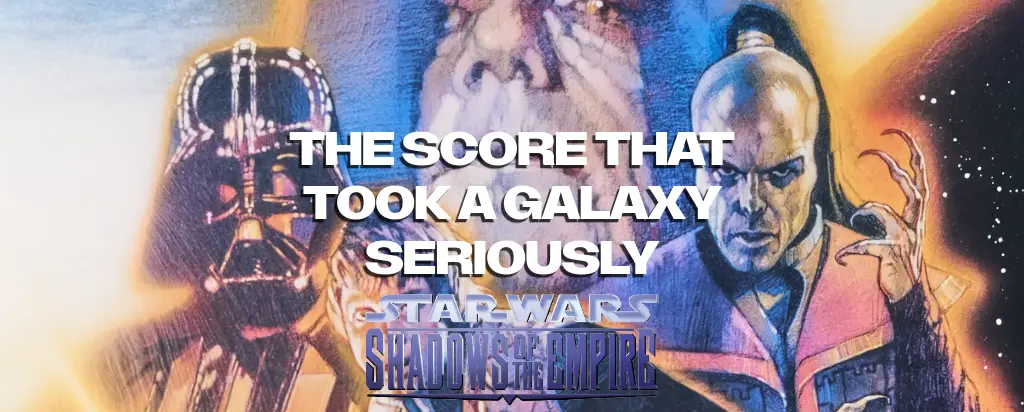
Decades before Disney Plus added episodic, made-for-TV content to help fill in the blanks between Star Wars films, Lucasfilm attempted something far more ambitious and far less precedented. In 1996, they launched Shadows of the Empire: a coordinated multimedia event that unfolded simultaneously across a novel, a comic book series, a Kenner toy line, and a Nintendo 64 video game.
There was no film. That was the point. They called it a movie without a movie, and for an entire generation of fans, it worked exactly like one.
What Was Shadows of the Empire?
Set in the gap between The Empire Strikes Back and Return of the Jedi, Shadows of the Empire occupied one of the most emotionally charged stretches of the original trilogy.
- Han Solo was frozen in carbonite.
- The Rebellion was scattered.
- Darth Vader was searching for his son.
Into that window, Lucasfilm introduced Dash Rendar, a mercenary in the mold of a younger, rougher Han Solo, and Prince Xizor, the head of the Black Sun criminal syndicate and one of the most calculating villains the Star Wars universe had produced outside of the Empire itself. The story gave fans something they had been quietly craving since 1983: new characters with real stakes, in a much seedier version of the Star Wars galaxy, pre Jabba the Hutt.
Shadows of the Empire also served as a reintroduction into a world that fans loved. By 1996, Star Wars had been culturally dormant for over a decade. Return of the Jedi had closed the book on the original trilogy in 1983, and while a small number of post-Jedi novels had kept the Expanded Universe technically alive, mainstream fandom had largely moved on. The kids who had grown up with Star Wars were now in their twenties, and the franchise had given them very little reason to stay engaged. A handful of paperbacks and a fading toy aisle were not enough to sustain a mythology of that scale.
Shadows of the Empire changed that overnight. It reminded a generation that Star Wars was still capable of delivering something new, and it laid the cultural groundwork for what came next. The Star Wars Special Editions arrived in theaters just one year later, in 1997, followed by the prequel trilogy announcement and a full-scale franchise revival that has not slowed since. In retrospect, Shadows of the Empire felt like a deliberate and carefully orchestrated reminder that the galaxy far, far away was not finished yet.
The Story of Dash Rendar and Prince Xizor
Shadows of the Empire is set in the gap between The Empire Strikes Back and Return of the Jedi. Han Solo remains frozen in carbonite. The Rebellion remains scattered throughout the galaxy. Luke Skywalker is still processing the Vader revelation. And two new characters orbit the ongoing crisis from opposite sides.
Dash Rendar is a smuggler hired to protect Luke while the Alliance searches for Han. He is a deliberate Han Solo surrogate: cocky, self-interested, piloting a freighter called the Outrider. He fights for the Rebellion first because the money is good, and then because it starts to matter. His fate at the end of the story is left deliberately ambiguous, which the fandom debated for years.
Prince Xizor is the villain, and one of the more compelling ones the Expanded Universe produced. As the head of Black Sun, the galaxy's most powerful criminal syndicate, he considers himself the third most powerful being in the Empire behind only the Emperor and Vader. His entire plan in Shadows is to eliminate Luke Skywalker and discredit Vader in the Emperor's eyes. The vendetta is personal: Vader once ordered the destruction of a Falleen city, killing Xizor's family in the process. Xizor simply built a criminal empire patient enough to get even.
The story ends above Coruscant. Return of the Jedi picks up almost exactly where Shadows leaves off. And remember that bounty hunter suit that Leia wears in Jedi? It has an entire origin story set in Shadows.
Why LucasArts Hired Joel McNeely Instead of John Williams
When Lucasfilm decided to release a standalone orchestral soundtrack album for Shadows of the Empire, it raised an immediate question: what exactly was this music for?
The answer was the multimedia event itself. Lucasfilm wanted every component of Shadows of the Empire to feel like a full-scale Star Wars release, and a full-scale Star Wars release had an orchestral score. The soundtrack was meant to give the entire event a cinematic center of gravity, something that tied the novel, the comic, the game, and the toy line together into something that felt, emotionally, like a film.
That meant hiring a composer. And that meant confronting a question the Star Wars universe had never really needed to answer before: what happens when John Williams is not available?
Lucasfilm hired Joel McNeely, an Emmy winner with over a hundred film and television credits, and gave him a genuinely unusual brief: write original Star Wars music without leaning on Williams' established themes.
Recorded with the Royal Scottish National Orchestra, his score wrote original themes for Xizor, Dash Rendar, Black Sun, and the Coruscant underworld that feel native to the Star Wars universe.
What McNeely's Score Actually Did
McNeely's score is a full orchestral work in the tradition of the great adventure film scores, sweeping, thematically rich, and constructed around motifs that give each major character and location their own musical identity. Xizor gets a theme that is cold and reptilian, all low brass and chromatic unease. Dash Rendar's music carries the swagger of a smuggler who doesn't quite believe in the cause yet. The Coruscant underworld gets textures that feel genuinely alien, urban in a way Star Wars had not really explored before.
What makes the score hold up is that McNeely understood his assignment without being limited by it. He was trying to sound like Star Wars, a goal that many other composers have since had to contend with throughout the connected Star Wars universe since the ‘90s. For collectors and Star Wars completists, the soundtrack remains one of the most ambitious and least discussed artifacts of the entire Shadows of the Empire project.
Shadows of the Empire in the Legends Universe Today
When Disney acquired Lucasfilm in 2012, the entire Expanded Universe was reclassified as Legends and stripped of canon status. Shadows of the Empire went with it. The story that once bridged two trilogies became officially a parallel timeline, a what-if that never happened.
But Legends has proven harder to retire than anyone expected.
Elements of Shadows of the Empire have already migrated into current canon without the story itself following. Black Sun has remained an active presence across The Clone Wars, Rebels, and Solo: A Star Wars Story. The organization survived. The characters built around it were left behind. For now.
With Dave Filoni fronting creative control at Lucasfilm, the odds of a revisit have become genuinely plausible. Grand Admiral Thrawn, Darth Bane, and others once exiled to Legends have returned in various forms. At Star Wars Celebration 2025, Filoni noted that many Legends elements would be carried forward as the franchise evolves. Whether Xizor or Dash Rendar are among them remains an open question, but it is no longer an unreasonable one.
In the meantime, the novel itself was reprinted by Penguin Random House in June 2025 as part of the Essential Legends Collection, with new cover art and the first-ever unabridged audiobook.
For collectors, that tension is part of the appeal. Shadows of the Empire is a complete artifact of a specific moment in Star Wars history: the 1996 reawakening, the multimedia experiment, the movie that never got made. That version of the story is not going anywhere.
Why This Score Belongs in a Serious Star Wars Collection
Before Shadows of The Empire was released in 1996, Star Wars fandom was deep underground. It was a time before smartphones, and before most fans had a reliable Internet connection. Star Wars fandom simply wasn’t connected.
You had to find your tribe, literally. Maybe they were wearing an old R2-D2 thrift store shirt or dropped a deep cut quote from the original trilogy. You knew when you found them. You just couldn’t enter a chatroom to discuss, dissect, and ponder future possibilities. Then you’d trade books.
“Here, check out this Zahn trilogy.”
“Not before you read ‘Tales of the Bounty Hunter.’”
Shadows of The Empire became the reconnection point for scores of lifelong fans. Suddenly, there was a new interconnected storyline to dissect, new characters to ponder, and new merchandise to showcase your Star Wars fandom.
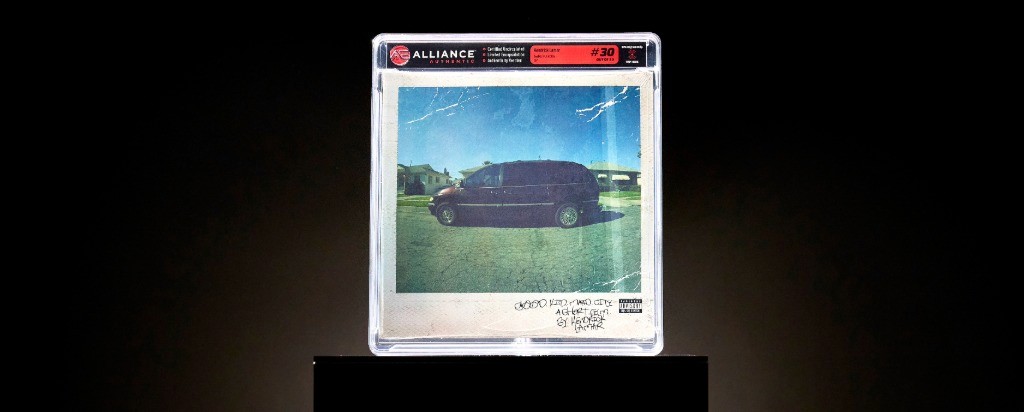
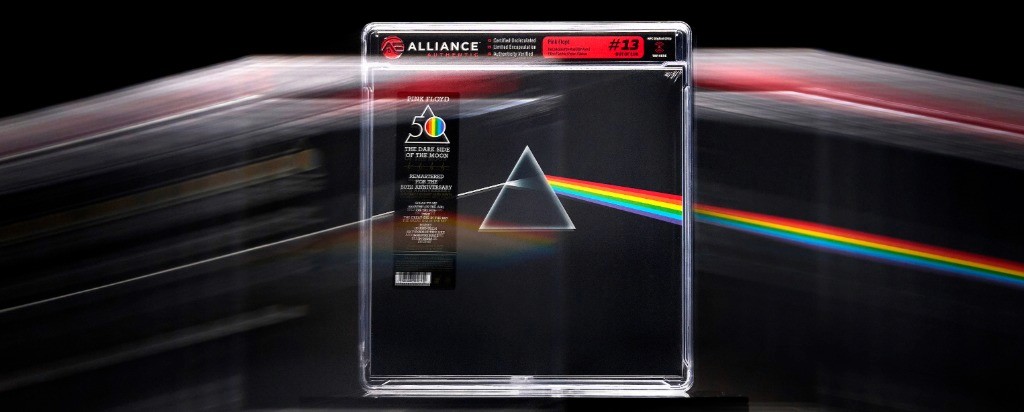
The Shadows of The Empire score, encapsulated by Alliance Authentic, is that wall presentation in the present tense. A signifier of your deep fandom, and the world of possibilities that followed the Star Wars Legends category.
You were there decades before The Mandalorian, and you’re not going anywhere.
What Alliance Authentic Preservation Means for a Record Like This
Alliance Authentic sourced these copies directly from the pressing source before they ever reached the open market. Uncirculated. Unhandled. Documented from origin.
Each copy is encapsulated and embedded with an NFC chip. Tap it with any smartphone and you access the Certified Copy record: verified authenticity, documented condition, and a full provenance chain from pressing source to you.
Two individually numbered copies exist in this state. That number does not change. Explore this rare piece of Star Wars fandom before the very limited run of numbered copies sells out.
Brian Tunney
Lifelong vinyl and CD collector with a focus on obscure indie labels of the '90s. And that's Pablo.

FIND YOUR FOREVER COPY
Some records are more important.
Preserve the ones that matter most.

Curated

Numbered

Limited

Certified Uncirculated

NFC-Secured


BE FIRST TO KNOW WHEN
PRESERVED RECORDS ARRIVE
Get alerts for new preserved records, curated drops and collector updates.
CURATED COLLECTIONS
LEARN


COLLECTOR GUIDE
Star Wars: Shadows of the Empire and the Score That Took a Galaxy Seriously
Star Wars: Shadows of the Empire and the Score That Took a Galaxy Seriously
Brian Tunney
5 Minutes Read
Decades before Disney Plus added episodic, made-for-TV content to help fill in the blanks between Star Wars films, Lucasfilm attempted something far more ambitious and far less precedented. In 1996, they launched Shadows of the Empire: a coordinated multimedia event that unfolded simultaneously across a novel, a comic book series, a Kenner toy line, and a Nintendo 64 video game.
There was no film. That was the point. They called it a movie without a movie, and for an entire generation of fans, it worked exactly like one.
What Was Shadows of the Empire?
Set in the gap between The Empire Strikes Back and Return of the Jedi, Shadows of the Empire occupied one of the most emotionally charged stretches of the original trilogy.
- Han Solo was frozen in carbonite.
- The Rebellion was scattered.
- Darth Vader was searching for his son.
Into that window, Lucasfilm introduced Dash Rendar, a mercenary in the mold of a younger, rougher Han Solo, and Prince Xizor, the head of the Black Sun criminal syndicate and one of the most calculating villains the Star Wars universe had produced outside of the Empire itself. The story gave fans something they had been quietly craving since 1983: new characters with real stakes, in a much seedier version of the Star Wars galaxy, pre Jabba the Hutt.
Shadows of the Empire also served as a reintroduction into a world that fans loved. By 1996, Star Wars had been culturally dormant for over a decade. Return of the Jedi had closed the book on the original trilogy in 1983, and while a small number of post-Jedi novels had kept the Expanded Universe technically alive, mainstream fandom had largely moved on. The kids who had grown up with Star Wars were now in their twenties, and the franchise had given them very little reason to stay engaged. A handful of paperbacks and a fading toy aisle were not enough to sustain a mythology of that scale.
Shadows of the Empire changed that overnight. It reminded a generation that Star Wars was still capable of delivering something new, and it laid the cultural groundwork for what came next. The Star Wars Special Editions arrived in theaters just one year later, in 1997, followed by the prequel trilogy announcement and a full-scale franchise revival that has not slowed since. In retrospect, Shadows of the Empire felt like a deliberate and carefully orchestrated reminder that the galaxy far, far away was not finished yet.
The Story of Dash Rendar and Prince Xizor
Shadows of the Empire is set in the gap between The Empire Strikes Back and Return of the Jedi. Han Solo remains frozen in carbonite. The Rebellion remains scattered throughout the galaxy. Luke Skywalker is still processing the Vader revelation. And two new characters orbit the ongoing crisis from opposite sides.
Dash Rendar is a smuggler hired to protect Luke while the Alliance searches for Han. He is a deliberate Han Solo surrogate: cocky, self-interested, piloting a freighter called the Outrider. He fights for the Rebellion first because the money is good, and then because it starts to matter. His fate at the end of the story is left deliberately ambiguous, which the fandom debated for years.
Prince Xizor is the villain, and one of the more compelling ones the Expanded Universe produced. As the head of Black Sun, the galaxy's most powerful criminal syndicate, he considers himself the third most powerful being in the Empire behind only the Emperor and Vader. His entire plan in Shadows is to eliminate Luke Skywalker and discredit Vader in the Emperor's eyes. The vendetta is personal: Vader once ordered the destruction of a Falleen city, killing Xizor's family in the process. Xizor simply built a criminal empire patient enough to get even.
The story ends above Coruscant. Return of the Jedi picks up almost exactly where Shadows leaves off. And remember that bounty hunter suit that Leia wears in Jedi? It has an entire origin story set in Shadows.
Why LucasArts Hired Joel McNeely Instead of John Williams
When Lucasfilm decided to release a standalone orchestral soundtrack album for Shadows of the Empire, it raised an immediate question: what exactly was this music for?
The answer was the multimedia event itself. Lucasfilm wanted every component of Shadows of the Empire to feel like a full-scale Star Wars release, and a full-scale Star Wars release had an orchestral score. The soundtrack was meant to give the entire event a cinematic center of gravity, something that tied the novel, the comic, the game, and the toy line together into something that felt, emotionally, like a film.
That meant hiring a composer. And that meant confronting a question the Star Wars universe had never really needed to answer before: what happens when John Williams is not available?
Lucasfilm hired Joel McNeely, an Emmy winner with over a hundred film and television credits, and gave him a genuinely unusual brief: write original Star Wars music without leaning on Williams' established themes.
Recorded with the Royal Scottish National Orchestra, his score wrote original themes for Xizor, Dash Rendar, Black Sun, and the Coruscant underworld that feel native to the Star Wars universe.
What McNeely's Score Actually Did
McNeely's score is a full orchestral work in the tradition of the great adventure film scores, sweeping, thematically rich, and constructed around motifs that give each major character and location their own musical identity. Xizor gets a theme that is cold and reptilian, all low brass and chromatic unease. Dash Rendar's music carries the swagger of a smuggler who doesn't quite believe in the cause yet. The Coruscant underworld gets textures that feel genuinely alien, urban in a way Star Wars had not really explored before.
What makes the score hold up is that McNeely understood his assignment without being limited by it. He was trying to sound like Star Wars, a goal that many other composers have since had to contend with throughout the connected Star Wars universe since the ‘90s. For collectors and Star Wars completists, the soundtrack remains one of the most ambitious and least discussed artifacts of the entire Shadows of the Empire project.
Shadows of the Empire in the Legends Universe Today
When Disney acquired Lucasfilm in 2012, the entire Expanded Universe was reclassified as Legends and stripped of canon status. Shadows of the Empire went with it. The story that once bridged two trilogies became officially a parallel timeline, a what-if that never happened.
But Legends has proven harder to retire than anyone expected.
Elements of Shadows of the Empire have already migrated into current canon without the story itself following. Black Sun has remained an active presence across The Clone Wars, Rebels, and Solo: A Star Wars Story. The organization survived. The characters built around it were left behind. For now.
With Dave Filoni fronting creative control at Lucasfilm, the odds of a revisit have become genuinely plausible. Grand Admiral Thrawn, Darth Bane, and others once exiled to Legends have returned in various forms. At Star Wars Celebration 2025, Filoni noted that many Legends elements would be carried forward as the franchise evolves. Whether Xizor or Dash Rendar are among them remains an open question, but it is no longer an unreasonable one.
In the meantime, the novel itself was reprinted by Penguin Random House in June 2025 as part of the Essential Legends Collection, with new cover art and the first-ever unabridged audiobook.
For collectors, that tension is part of the appeal. Shadows of the Empire is a complete artifact of a specific moment in Star Wars history: the 1996 reawakening, the multimedia experiment, the movie that never got made. That version of the story is not going anywhere.
Why This Score Belongs in a Serious Star Wars Collection
Before Shadows of The Empire was released in 1996, Star Wars fandom was deep underground. It was a time before smartphones, and before most fans had a reliable Internet connection. Star Wars fandom simply wasn’t connected.
You had to find your tribe, literally. Maybe they were wearing an old R2-D2 thrift store shirt or dropped a deep cut quote from the original trilogy. You knew when you found them. You just couldn’t enter a chatroom to discuss, dissect, and ponder future possibilities. Then you’d trade books.
“Here, check out this Zahn trilogy.”
“Not before you read ‘Tales of the Bounty Hunter.’”
Shadows of The Empire became the reconnection point for scores of lifelong fans. Suddenly, there was a new interconnected storyline to dissect, new characters to ponder, and new merchandise to showcase your Star Wars fandom.
The Shadows of The Empire score, encapsulated by Alliance Authentic, is that wall presentation in the present tense. A signifier of your deep fandom, and the world of possibilities that followed the Star Wars Legends category.
You were there decades before The Mandalorian, and you’re not going anywhere.
What Alliance Authentic Preservation Means for a Record Like This
Alliance Authentic sourced these copies directly from the pressing source before they ever reached the open market. Uncirculated. Unhandled. Documented from origin.
Each copy is encapsulated and embedded with an NFC chip. Tap it with any smartphone and you access the Certified Copy record: verified authenticity, documented condition, and a full provenance chain from pressing source to you.
Two individually numbered copies exist in this state. That number does not change. Explore this rare piece of Star Wars fandom before the very limited run of numbered copies sells out.
Brian Tunney
Lifelong vinyl and CD collector with a focus on obscure indie labels of the '90s. And that's Pablo.
FIND YOUR FOREVER COPY
Some records are more important.
Preserve the ones that matter most.
Curated
Numbered
Limited
Certified Uncirculated
NFC-Secured
BE FIRST TO KNOW WHEN PRESERVED RECORDS ARRIVE
Get alerts for new preserved records, curated drops and collector updates.
CURATED COLLECTIONS
LEARN

COLLECTOR GUIDE
Star Wars: Shadows of the Empire and the Score That Took a Galaxy Seriously
Brian Tunney
5 Minutes Read
Decades before Disney Plus added episodic, made-for-TV content to help fill in the blanks between Star Wars films, Lucasfilm attempted something far more ambitious and far less precedented. In 1996, they launched Shadows of the Empire: a coordinated multimedia event that unfolded simultaneously across a novel, a comic book series, a Kenner toy line, and a Nintendo 64 video game.
There was no film. That was the point. They called it a movie without a movie, and for an entire generation of fans, it worked exactly like one.
What Was Shadows of the Empire?
Set in the gap between The Empire Strikes Back and Return of the Jedi, Shadows of the Empire occupied one of the most emotionally charged stretches of the original trilogy.
- Han Solo was frozen in carbonite.
- The Rebellion was scattered.
- Darth Vader was searching for his son.
Into that window, Lucasfilm introduced Dash Rendar, a mercenary in the mold of a younger, rougher Han Solo, and Prince Xizor, the head of the Black Sun criminal syndicate and one of the most calculating villains the Star Wars universe had produced outside of the Empire itself. The story gave fans something they had been quietly craving since 1983: new characters with real stakes, in a much seedier version of the Star Wars galaxy, pre Jabba the Hutt.
Shadows of the Empire also served as a reintroduction into a world that fans loved. By 1996, Star Wars had been culturally dormant for over a decade. Return of the Jedi had closed the book on the original trilogy in 1983, and while a small number of post-Jedi novels had kept the Expanded Universe technically alive, mainstream fandom had largely moved on. The kids who had grown up with Star Wars were now in their twenties, and the franchise had given them very little reason to stay engaged. A handful of paperbacks and a fading toy aisle were not enough to sustain a mythology of that scale.
Shadows of the Empire changed that overnight. It reminded a generation that Star Wars was still capable of delivering something new, and it laid the cultural groundwork for what came next. The Star Wars Special Editions arrived in theaters just one year later, in 1997, followed by the prequel trilogy announcement and a full-scale franchise revival that has not slowed since. In retrospect, Shadows of the Empire felt like a deliberate and carefully orchestrated reminder that the galaxy far, far away was not finished yet.
The Story of Dash Rendar and Prince Xizor
Shadows of the Empire is set in the gap between The Empire Strikes Back and Return of the Jedi. Han Solo remains frozen in carbonite. The Rebellion remains scattered throughout the galaxy. Luke Skywalker is still processing the Vader revelation. And two new characters orbit the ongoing crisis from opposite sides.
Dash Rendar is a smuggler hired to protect Luke while the Alliance searches for Han. He is a deliberate Han Solo surrogate: cocky, self-interested, piloting a freighter called the Outrider. He fights for the Rebellion first because the money is good, and then because it starts to matter. His fate at the end of the story is left deliberately ambiguous, which the fandom debated for years.
Prince Xizor is the villain, and one of the more compelling ones the Expanded Universe produced. As the head of Black Sun, the galaxy's most powerful criminal syndicate, he considers himself the third most powerful being in the Empire behind only the Emperor and Vader. His entire plan in Shadows is to eliminate Luke Skywalker and discredit Vader in the Emperor's eyes. The vendetta is personal: Vader once ordered the destruction of a Falleen city, killing Xizor's family in the process. Xizor simply built a criminal empire patient enough to get even.
The story ends above Coruscant. Return of the Jedi picks up almost exactly where Shadows leaves off. And remember that bounty hunter suit that Leia wears in Jedi? It has an entire origin story set in Shadows.
Why LucasArts Hired Joel McNeely Instead of John Williams
When Lucasfilm decided to release a standalone orchestral soundtrack album for Shadows of the Empire, it raised an immediate question: what exactly was this music for?
The answer was the multimedia event itself. Lucasfilm wanted every component of Shadows of the Empire to feel like a full-scale Star Wars release, and a full-scale Star Wars release had an orchestral score. The soundtrack was meant to give the entire event a cinematic center of gravity, something that tied the novel, the comic, the game, and the toy line together into something that felt, emotionally, like a film.
That meant hiring a composer. And that meant confronting a question the Star Wars universe had never really needed to answer before: what happens when John Williams is not available?
Lucasfilm hired Joel McNeely, an Emmy winner with over a hundred film and television credits, and gave him a genuinely unusual brief: write original Star Wars music without leaning on Williams' established themes.
Recorded with the Royal Scottish National Orchestra, his score wrote original themes for Xizor, Dash Rendar, Black Sun, and the Coruscant underworld that feel native to the Star Wars universe.
What McNeely's Score Actually Did
McNeely's score is a full orchestral work in the tradition of the great adventure film scores, sweeping, thematically rich, and constructed around motifs that give each major character and location their own musical identity. Xizor gets a theme that is cold and reptilian, all low brass and chromatic unease. Dash Rendar's music carries the swagger of a smuggler who doesn't quite believe in the cause yet. The Coruscant underworld gets textures that feel genuinely alien, urban in a way Star Wars had not really explored before.
What makes the score hold up is that McNeely understood his assignment without being limited by it. He was trying to sound like Star Wars, a goal that many other composers have since had to contend with throughout the connected Star Wars universe since the ‘90s. For collectors and Star Wars completists, the soundtrack remains one of the most ambitious and least discussed artifacts of the entire Shadows of the Empire project.
Shadows of the Empire in the Legends Universe Today
When Disney acquired Lucasfilm in 2012, the entire Expanded Universe was reclassified as Legends and stripped of canon status. Shadows of the Empire went with it. The story that once bridged two trilogies became officially a parallel timeline, a what-if that never happened.
But Legends has proven harder to retire than anyone expected.
Elements of Shadows of the Empire have already migrated into current canon without the story itself following. Black Sun has remained an active presence across The Clone Wars, Rebels, and Solo: A Star Wars Story. The organization survived. The characters built around it were left behind. For now.
With Dave Filoni fronting creative control at Lucasfilm, the odds of a revisit have become genuinely plausible. Grand Admiral Thrawn, Darth Bane, and others once exiled to Legends have returned in various forms. At Star Wars Celebration 2025, Filoni noted that many Legends elements would be carried forward as the franchise evolves. Whether Xizor or Dash Rendar are among them remains an open question, but it is no longer an unreasonable one.
In the meantime, the novel itself was reprinted by Penguin Random House in June 2025 as part of the Essential Legends Collection, with new cover art and the first-ever unabridged audiobook.
For collectors, that tension is part of the appeal. Shadows of the Empire is a complete artifact of a specific moment in Star Wars history: the 1996 reawakening, the multimedia experiment, the movie that never got made. That version of the story is not going anywhere.
Why This Score Belongs in a Serious Star Wars Collection
Before Shadows of The Empire was released in 1996, Star Wars fandom was deep underground. It was a time before smartphones, and before most fans had a reliable Internet connection. Star Wars fandom simply wasn’t connected.
You had to find your tribe, literally. Maybe they were wearing an old R2-D2 thrift store shirt or dropped a deep cut quote from the original trilogy. You knew when you found them. You just couldn’t enter a chatroom to discuss, dissect, and ponder future possibilities. Then you’d trade books.
“Here, check out this Zahn trilogy.”
“Not before you read ‘Tales of the Bounty Hunter.’”
Shadows of The Empire became the reconnection point for scores of lifelong fans. Suddenly, there was a new interconnected storyline to dissect, new characters to ponder, and new merchandise to showcase your Star Wars fandom.
The Shadows of The Empire score, encapsulated by Alliance Authentic, is that wall presentation in the present tense. A signifier of your deep fandom, and the world of possibilities that followed the Star Wars Legends category.
You were there decades before The Mandalorian, and you’re not going anywhere.
What Alliance Authentic Preservation Means for a Record Like This
Alliance Authentic sourced these copies directly from the pressing source before they ever reached the open market. Uncirculated. Unhandled. Documented from origin.
Each copy is encapsulated and embedded with an NFC chip. Tap it with any smartphone and you access the Certified Copy record: verified authenticity, documented condition, and a full provenance chain from pressing source to you.
Two individually numbered copies exist in this state. That number does not change. Explore this rare piece of Star Wars fandom before the very limited run of numbered copies sells out.
Brian Tunney
Lifelong vinyl and CD collector with a focus on obscure indie labels of the '90s. And that's Pablo.
FIND YOUR FOREVER COPY
Some records are more important.
Preserve the ones that matter most.
Curated
Numbered
Limited
Certified Uncirculated
NFC-Secured
BE FIRST TO KNOW WHEN PRESERVED RECORDS ARRIVE
Get alerts for new preserved records, curated drops and collector updates.
CURATED COLLECTIONS
LEARN